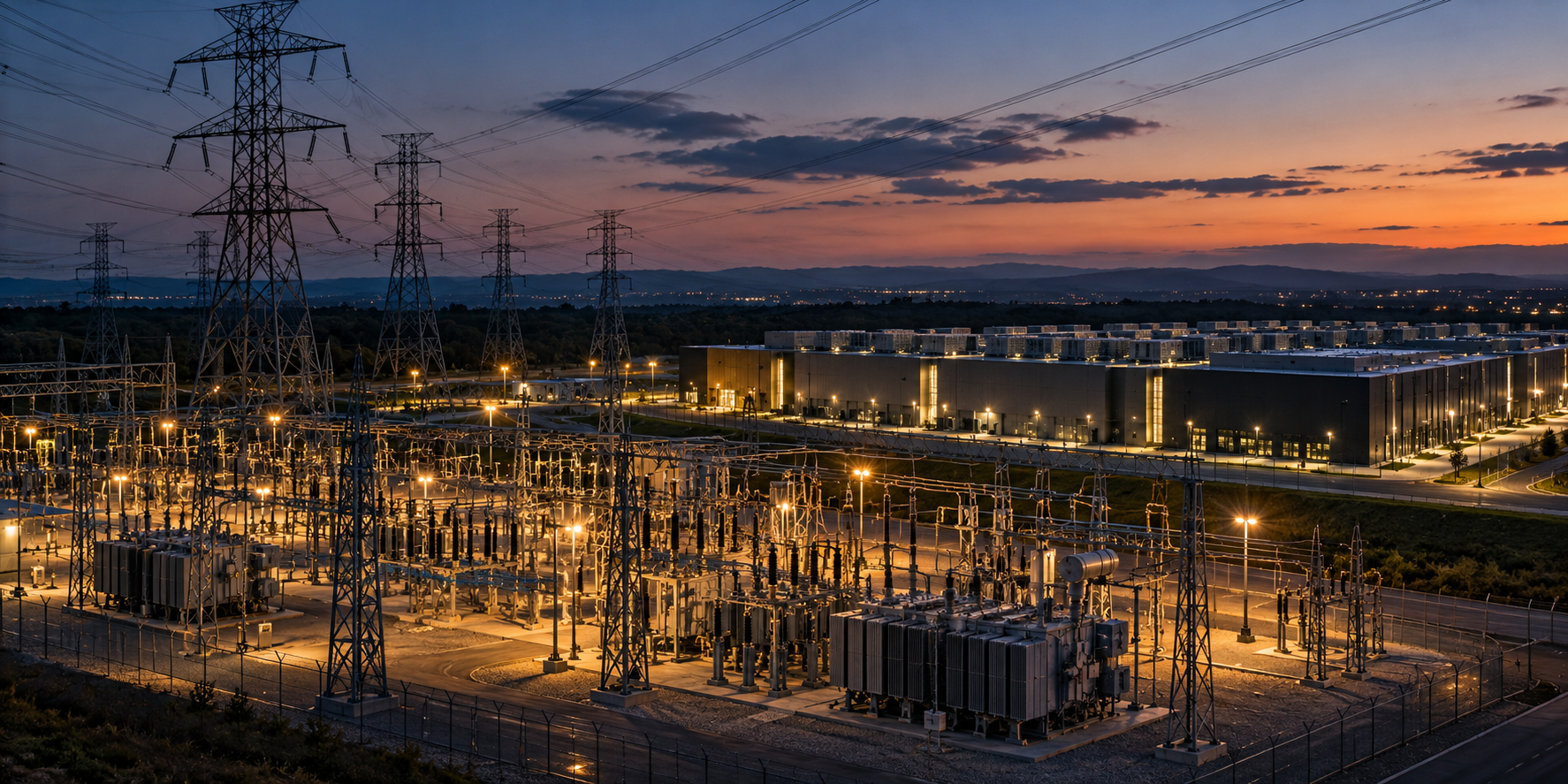
Every AI answer has a physical cost behind it: processors, servers, buildings, cooling and electricity. Financing those assets creates a second contest alongside the race to build better models—the race to turn investment into durable cash earnings.
01 / FOLLOW THE MONEYFour pools of capital, one connected trade
Microsoft, Amazon, Alphabet and Meta are not interchangeable AI investments. Their established cloud, advertising, software and commerce businesses support the buildout, but infrastructure spending competes with buybacks, dividends and other investment. Amazon illustrates the tension: trailing-year operating cash flow rose to $161.4 billion, while free cash flow fell to a $7.6 billion outflow after rising property-and-equipment purchases. A profitable business can still consume cash after investment. [2]
The operating businesses
Customers and advertisers generate cash that can finance servers and buildings. The key test is how much remains after investment.
Watch: operating cash flow and free cash flow.Shareholders fund expansion
New shares and preferred securities bring permanent capital, but existing owners can face dilution. Alphabet reported $49.6bn of net proceeds from equity and mandatory convertible preferred issuance in June. [3]
Watch: share count and returns per share.Bond and loan investors
Debt transfers part of the funding burden to creditors. The WSJ reported Broadcom was arranging more than $50bn for OpenAI custom chips; this was a reported financing discussion, not a completed deal. [6]
Watch: leverage, spreads and refinancing costs.Infrastructure and compute finance
Nvidia announced partnerships seeking to mobilize over $500bn of third-party capital over time, subject to definitive agreements. That is an ambition, not cash already deployed. [1]
Watch: contracts, guarantees and collateral value.Bloomberg highlights AI infrastructure’s growing reliance on outside funding. [7] The distinction that matters is who owes the money. A corporate bond relies on the issuer’s wider business; a project loan may depend on a particular tenant, site and contract. Moving assets into a separate vehicle does not remove the economic risk. It changes where that risk sits.
Compute financing adds an unusual underwriting problem: the building may last for decades, while the most valuable equipment can become commercially outdated much sooner. Reuters reported lenders challenging Nvidia’s assumptions about GPU residual values and seeking stronger contractual support. [9] My interpretation is that an impressive chip is not sufficient collateral by itself. Repayment still needs dependable customers and cash flow.
02 / EARNINGS CHECKRevenue growth is only the first test
The latest reported quarters show strong demand, but they also show why investors need several measures of success. Cloud growth, operating profit and cash after investment answer different questions. These periods are identified individually; they are not a perfectly synchronized set of earnings. [1] [2] [3] [4] [5]
| COMPANY / PERIOD | REPORTED RESULT | WHAT TO WATCH NEXT · AUTHOR ANALYSIS |
|---|---|---|
| NVDAQ2 FY27 Ended Jul 26 | Revenue $96.2bn, +106% YoY. GAAP diluted EPS $2.46. [1] | Customer budgets, new-product execution and whether supplier financing increases exposure to customer risk. |
| MSFTQ4 FY26 Ended Jun 30 | Revenue $90.0bn; GAAP net income $35.8bn. Azure growth +43%. [4] | Capacity turning into paid usage, cloud margins and the cash obligations behind leases. |
| AMZNQ2 2026 Ended Jun 30 | AWS revenue $42.2bn, +37%; AWS operating income $16.6bn. [2] | Cash conversion after infrastructure investment; separate operating performance from gains on investments. |
| GOOG / GOOGLQ2 2026 Ended Jun 30 | Revenue $119.8bn, +24%; operating income $40.8bn. Google Cloud revenue $24.8bn. [3] | Cloud economics, search monetization and the balance between growth and dilution. |
| METAQ2 2026 Ended Jun 30 | Revenue $60.8bn, +28%; GAAP net income $15.8bn, −14%. [5] | Whether ad improvements compensate for infrastructure spending and higher expenses. |
Amazon’s $62.6 billion net income included $53.4 billion of non-operating pre-tax other income, primarily from Anthropic investments. The different tax bases prevent directly subtracting these figures to find “underlying profit.” Operating results and cash flow better distinguish business performance from investment gains. [2]
For the company-specific earnings and expense discussion, see Note 004: Meta’s Muse Rally. Here, the focus is on how the wider buildout is financed.
03 / THE EQUITY TAPEThe market rewards different parts of the chain
On October 5, Nvidia rose 2.1%, Microsoft about 1.5%, and Meta about 2%, while the Nasdaq gained 1.05%. Reuters described a session supported by lower oil and changing rate expectations as investors approached earnings. [10] A stock move is not a clean measure of AI fundamentals: discount rates, positioning and the broader market also matter.
One session, different reactions
October 5, 2026 close · Daily price change · Rounded as reported
The longer picture can diverge from one session. Yahoo Finance reported on October 5 that Amazon had fallen 2.4% over the preceding month while Meta had rallied 23%. Its discussion also highlighted Amazon’s spending burden and company-specific regulatory concerns. [12] My inference: buying several large AI names does not guarantee the same exposure, but owning the supplier, its customer and its infrastructure financier can still leave a portfolio dependent on the same spending cycle.
04 / THE PHYSICAL BOTTLENECKYou cannot finance your way around a missing grid connection
A server generates no customer revenue while it waits for power. Grid connections, generation equipment and reliable supply can therefore affect when an investment becomes productive. The IEA’s updated central projection puts global data-center electricity consumption at roughly 950 TWh in 2030, compared with 485 TWh in 2025. These figures cover all data centers, not AI alone. [8]
Electricity is part of the funding story
Global data-center electricity consumption · TWh per year
The IEA flags energy-equipment constraints and slower electricity investment. [8] My implication: contracted power access deserves scrutiny alongside chip orders. For utilities, shareholder returns depend on tariffs, cost allocation and execution. A bigger load does not automatically mean a better stock.
For credit investors, I would ask: does interest accrue before the site earns revenue? Who absorbs a construction delay? Is the customer contract firm enough to support debt service? Those questions connect a technology story to familiar infrastructure and project-finance risks.
05 / THE REVENUE AT THE ENDAI as a tool: who pays for the productivity?
Infrastructure ultimately needs a paying use case. AI may help employees draft documents, search information, assist customers and write code, but the economic value depends on how much useful work gets completed after checking the output. Time saved is not automatically revenue earned.
The ILO’s 2025 assessment found that one in four workers globally was in an occupation with some generative-AI exposure. It emphasized transformation of jobs, rather than wholesale redundancy, because human input remains necessary. Exposure is not a predicted layoff rate. [13] An NBER study of customer-support work found roughly 14% higher productivity with AI assistance, with benefits concentrated among less-experienced workers. That is evidence from a particular setting, not a universal productivity assumption. [14]
My view for finance is that AI’s strongest near-term role is assisting research and preparation while people retain responsibility for valuation, execution and client judgment. The investment question is who captures the benefit: the employer through lower costs, the worker through higher output, the customer through lower prices, or the AI provider through subscription and usage fees. These outcomes imply very different returns on the same infrastructure.
06 / FORWARD VIEWPredictions need an assumption, not just a target
Nvidia guided to $108 billion of revenue, plus or minus 2%, for Q3 FY2027. That is management’s outlook, not a realized result. [1] Meta’s quarterly guidance and valuation sensitivity are covered separately in Note 004.
Microsoft’s July call put calendar-2026 capex at approximately $175 billion after a shift from finance to operating leases changed its earlier $190 billion expectation. Accounting presentation matters: a smaller capex headline need not represent a proportionate reduction in economic spending. [15] Separately, Yahoo Finance reported Evercore ISI estimates of Amazon capex at $320 billion in 2027 and $370 billion in 2028, with roughly $50 billion of negative free cash flow in each year. That is one analyst’s outlook—not consensus, management guidance or my forecast. [12]
The scenarios below are my qualitative framework for the next 12–24 months. They carry no assigned probabilities or price targets. Open each case to compare the assumptions.
Demand converts into cashCONSTRUCTIVE CASE · AUTHOR SCENARIO
Paid usage grows fast enough to absorb new capacity, power becomes available on time, and margins stabilize. Suppliers retain demand while cloud companies demonstrate better cash conversion. The evidence I would want is improving free cash flow alongside usage and cloud growth—not simply another larger spending announcement.
AI grows, but returns take longerMIXED CASE · AUTHOR SCENARIO
Customers adopt AI, but falling prices and ongoing investment delay returns. Strong technology adoption coexists with weaker shareholder cash flow. Equity leadership can become selective, while well-protected credit may fare differently from unsecured growth exposure.
Funding tightens before monetization arrivesSTRESS CASE · AUTHOR SCENARIO
Usage disappoints, electricity or construction delays persist, or financing costs rise. Companies slow new orders and seek additional capital. Risks can spread across chips, cloud, infrastructure and lenders because their revenues ultimately depend on related customers.
07 / THE S&T LENSTrade the cash-flow chain
I would organize this theme around relative performance and credit quality rather than a single “AI is bullish” call. Strong AI revenue can help one company while the corresponding spending constrains another’s free cash flow. The price paid for exposure—and the expectations embedded in it—still determine the trade.
Equities
Compare suppliers with infrastructure buyers. Track earnings revisions, margins and cash conversion before concluding that a spending increase benefits every AI stock.
Credit
Watch issuance concessions, spreads and debt-service protection. Compare corporate obligations with site- or equipment-specific exposure; contracts matter more than the AI label.
Rates and energy
Higher yields can raise funding costs and lower the present value of future earnings. Power access affects operating timing; the magnitude differs by issuer and project.
What would change my view?
Persistent cloud growth with improving cash conversion would strengthen the thesis. Weak utilization, falling margins, repeated funding needs or delayed power access would weaken it.
Sources & research notes
Information checked October 7, 2026 ET. This article combines reported results, attributed reporting and clearly identified author analysis. Stock comparisons are dated snapshots; no live feed is used. Fiscal periods and cash-flow definitions differ. Charts reproduce only stated observations or labeled projections. Paywalled sources are used only for accessible reporting; some links require a subscription. Educational research, not a calibrated forecast or personalized investment recommendation.
- Nvidia · Q2 FY2027 financial resultsAug 26, 2026 · Revenue, EPS, forward guidance and proposed third-party compute financing.
- Amazon · Second-quarter 2026 resultsJul 30, 2026 · AWS revenue and profit; trailing cash flow; investment gains.
- Alphabet · Q2 2026 earnings release, SEC exhibitJul 22, 2026 · Revenue, operating income, Google Cloud and equity funding.
- Microsoft · FY2026 fourth-quarter resultsJul 29, 2026 · Revenue, GAAP net income and Azure growth.
- Meta · Second-quarter 2026 resultsJul 29, 2026 · Revenue, net income, expense items and guidance.
- The Wall Street Journal · Oracle, Broadcom and SpaceX seek chip financingOct 7, 2026 · Reported financing discussions; not completed transactions.
- Bloomberg · AI infrastructure fundingFeb 2, 2026 · Introductory reporting.
- IEA · Key Questions on Energy and AI, executive summary2026 update · 2025 electricity estimate, 2030 central projection and grid bottlenecks.
- Reuters · Nvidia compute financing meets lender scrutinyOct 1, 2026 · Residual-value and contractual-protection concerns.
- Reuters · Nasdaq record close ahead of earningsOct 5, 2026 · Daily moves and market context; rounded stock changes.
- MarketWatch · Alphabet Class C closing performanceOct 5, 2026 · GOOG and S&P 500 daily price changes.
- Yahoo Finance · Amazon’s valuation, spending and cash-flow outlookBrian Sozzi, Oct 5, 2026 · Monthly stock comparisons and attributed Evercore ISI estimates.
- ILO · Generative AI and jobs: a 2025 updateMay 20, 2025 · Occupational exposure and job transformation.
- Brynjolfsson, Li & Raymond · Generative AI at WorkNBER Working Paper 31161, 2023 · Task-specific productivity evidence; findings do not establish economy-wide gains.
- Microsoft · FY2026 fourth-quarter earnings callJul 29, 2026 · Calendar-year capex outlook and lease classification.