
My main question this Q3 earnings season is whether corporate results can support the market while investors reassess the Fed’s next move. I would connect two expectations: the profits investors think companies will earn, and the interest-rate path used to value those profits. Banks provide the opening signal; the broader story comes from demand, costs and investment across the economy.
01 / THE MARKET SIGNALWhat earnings season tells us about the economy.
October 13 brought third-quarter earnings releases from major U.S. banks. I’m reading those reports for signals about borrowing, saving, investment and client activity. Together, they offer a timely view of how households and companies are navigating interest rates. [1] [2] [3]
From earnings to the wider market
A conceptual reading guide, not a ranking of institutions.
Loan demand and repayment patterns help put consumer spending in context.
Financing and deal activity offer clues about confidence and investment plans.
Client activity and guidance help investors reassess the outlook for growth and rates.
My interpretation framework, informed by sources [1–3] and [5].
03 / MY Q3 MARKET PERSPECTIVEEarnings expectations meet rate expectations.
Are customers buying more?
I would separate price increases from volume growth. Stronger sales can reflect more demand, higher prices, or both. That distinction matters when judging growth alongside inflation.
What happens to the cost pressure?
I would listen for wages, energy, materials and financing costs across industries. The question is whether companies can protect earnings without relying on repeated price increases.
Is spending becoming productive capacity?
AI, factories, power grids and other investment can support future growth. I would ask when that spending becomes revenue or efficiency, and how much capital it requires along the way.
What was already expected?
A strong quarter may already be reflected in the share price. I would focus on whether the outlook changes expected future earnings enough to offset any change in the expected rate path.
My interpretation framework for reading Q3 reports across sectors. These are questions to investigate, not claims that every industry has reported the same results.
04 / OCTOBER 27–28A pause would not mean the hiking risk is gone.
The Fed raised its target range by 25 basis points to 3.75–4.00% in September. Its next scheduled meeting is October 27–28. The September minutes describe elevated inflation alongside solid activity and a stable labor market. [6]
As of October 13, Reuters reported that several officials had suggested another increase could come in December rather than October. That supports an October hold as a plausible base case—not a promise. Boston Fed President Susan Collins still supported further tightening before year-end, with timing dependent on incoming data. [7]
My market interpretation is that Fed actions can affect both sides of the equity story. A higher expected rate path can increase financing costs and the discount rate applied to future earnings. At the same time, companies’ demand, margins and investment determine those earnings. Strong profit growth may help offset valuation pressure; weaker guidance may make the market more sensitive to rates. The balance varies by sector and by company, so I would not treat one Fed decision as a uniform instruction for the whole market.
05 / INTERACTIVE DESK VIEWChange the Fed message.
Same rate decision, different market message
Select a scenario to explore the channels. Qualitative illustrations, not calibrated return forecasts.
My stock-price framework is to compare what was reported with what investors expected, then ask whether the news changes future earnings or the valuation investors will pay. Strong earnings already anticipated can leave little upside; guidance or credit concerns can outweigh the headline beat. These are possible mechanisms, not a claim that a particular factor caused every October 13 price move.
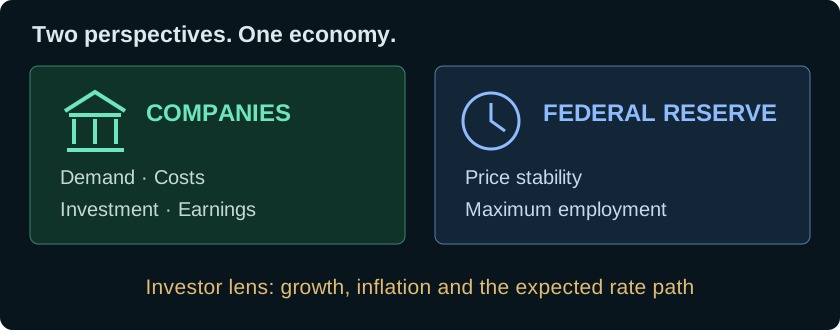
For me, corporate earnings and Fed policy offer two useful perspectives on the same economy. Companies across sectors show how customers are spending and how businesses are investing and managing costs; the Fed assesses whether that activity is consistent with price stability and maximum employment. I would connect those perspectives to the expected rate path, while recognizing that an expected pause does not guarantee a rally.
Sources & research notes
- JPMorgan Chase — Q3 2026 earnings releaseOctober 13, 2026. Background on lending, deposits and client activity.
- Goldman Sachs — Q3 2026 resultsOctober 13, 2026. Background on financing and markets activity.
- Citigroup — Q3 2026 earnings filingOctober 13, 2026. Background on economic and client activity.
- Reuters — JPMorgan earnings versus expectationsOctober 13, 2026. LSEG consensus EPS; consensus-provider distinctions matter.
- FDIC — 2026 Risk ReviewFunding, securities values, profitability and credit-risk channels.
- Federal Reserve — September 15–16 minutesReleased October 7, 2026. Policy action, economic assessment and October meeting dates.
- Reuters — Collins and the remaining 2026 meetingsOctober 13, 2026. Further tightening risk and conditional timing.
- S&P Dow Jones Indices — GICS sector classificationThe 11-sector structure used in the interactive guide.
- BLS — September 2026 CPI releaseReleased October 14, 2026. Headline and core annual changes; dated update.
- Reuters — October Fed outlook after inflation dataOctober 14, 2026. Market expectations can change during the session.
Written by Kevin Lu with research and editorial assistance. Published October 13, 2026; broadened and updated October 14, 2026. Earlier policy commentary remains dated. Expectations can change. Commentary and interactive cases are educational interpretations; no numeric stock-return forecast is presented. All prose is paraphrased; links identify the underlying evidence.